
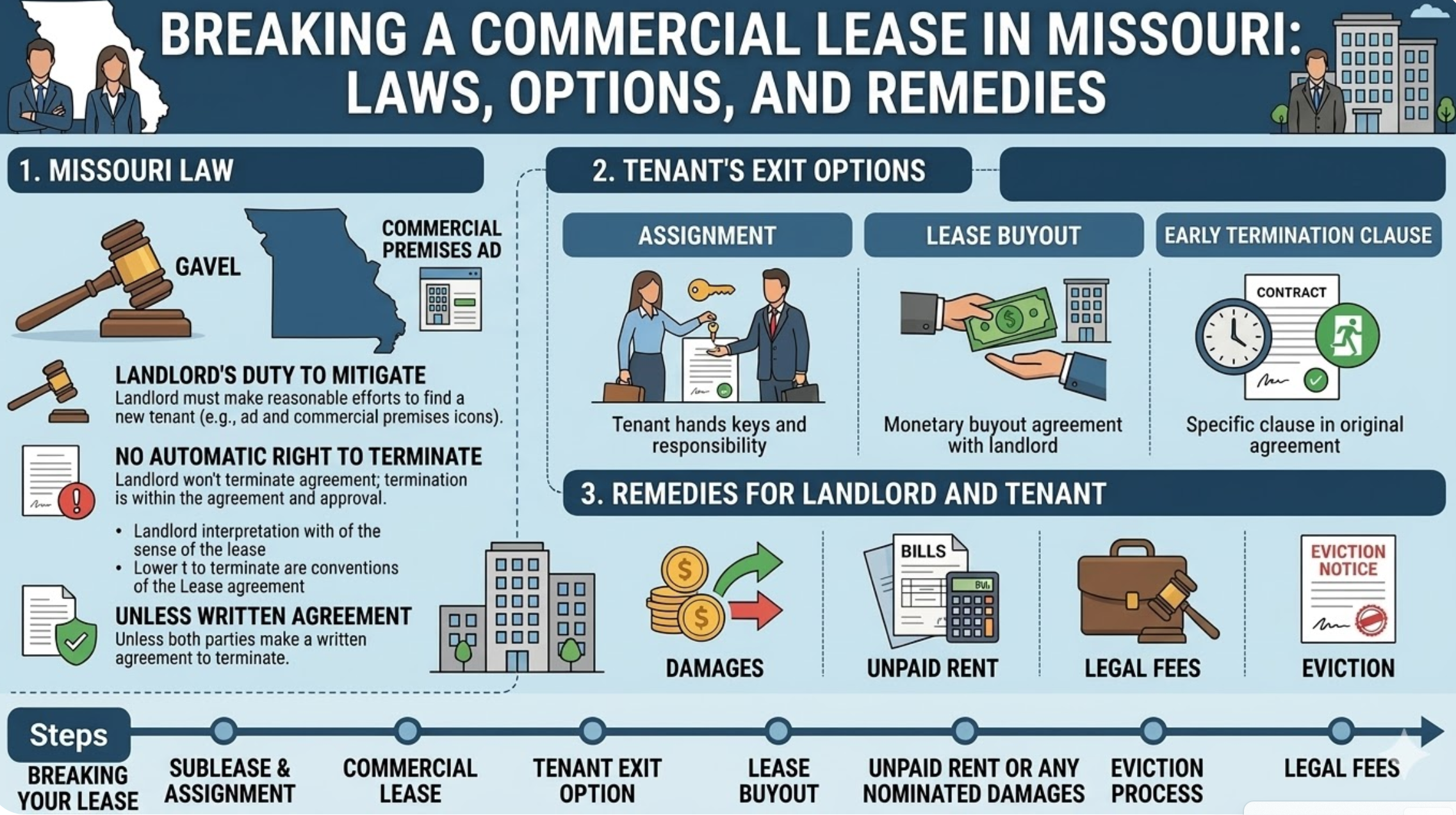
Breaking a Commercial Lease in Missouri: Laws, Options, and Remedies
Exiting a commercial lease before its expiration date is rarely simple. Missouri law enforces commercial lease agreements between sophisticated parties, which means tenants generally cannot walk away without consequences. However, depending on the circumstances, there may be legal grounds for termination or a negotiated exit.
Commercial Lease Termination Under Missouri Laws
Missouri recognizes several grounds that may allow a tenant to legally terminate a commercial lease: material breach by the landlord, constructive eviction, destruction of the leased premises, or mutual agreement. Force majeure clauses — highly relevant during COVID-19 disputes — may also apply depending on the lease language.
Tenants must review default and remedy provisions carefully before acting. Landlords facing the reverse scenario — a tenant who stops paying and files for bankruptcy — should read our article on landlord rights after tenant bankruptcy in Kansas City.
• Review lease termination and default clauses
• Identify any landlord breaches that may justify early exit
• Evaluate subletting or assignment as alternatives
• Negotiate a mutual termination agreement when possible
• Document all landlord communications before taking action
Real Estate Partition Lawsuit Attorney Fees in Missouri
Partition lawsuits can be expensive, and understanding the fee structure before filing is important. In Missouri, attorney fees in partition actions may be awarded from the proceeds of the sale or the common fund, depending on the court’s determination of what is equitable.
Typical costs include attorney fees, court filing fees, referee fees, survey costs, and costs of sale. Before deciding whether to file, review our breakdown of partition in kind vs partition by sale in Kansas City — the type of partition ordered directly affects total litigation cost.
Cloud on Title Removal Process in Kansas City
A cloud on title is any claim, lien, or encumbrance that raises questions about ownership validity. Common examples include unresolved mechanics liens, old mortgages not properly discharged, disputed easements, or errors in the chain of title.
If the cloud involves an unpaid contractor claim, our guide on how to remove a mechanics lien from property in KC is a useful starting point. For broader title uncertainty, a quiet title action in Kansas City may be the appropriate remedy.
Kansas City Zoning Board of Appeals: What an Attorney Can Do
The Kansas City Zoning Board of Appeals hears requests for variances, special use permits, and appeals of administrative decisions. Property owners who are denied a permit or whose projects face zoning obstacles have the right to appeal. The process involves submitting a formal application, presenting evidence, and attending a hearing.
An attorney can frame your variance request persuasively and ensure procedural requirements are met. Property owners managing multiple regulatory challenges may also face a concurrent commercial property tax appeal in Missouri — both proceedings benefit from early legal involvement.
Breach of Real Estate Contract Remedies in Missouri
When a party fails to perform under a real estate purchase contract in Missouri, the non-breaching party has several potential remedies: specific performance, monetary damages, or rescission of the contract with return of deposits. Courts in Missouri have regularly awarded specific performance in real estate cases because land is considered legally unique.
The appropriate remedy depends on the facts, the contract language, and the amount of harm suffered. In cases where a transaction falls apart due to financing issues, these remedies often intersect with short sale legal considerations for homeowners in Kansas City.
Seller Failed to Disclose Foundation Issues in Kansas City
Missouri requires sellers of residential property to disclose known material defects, including foundation problems. When a seller failed to disclose foundation issues in a Kansas City transaction, the buyer may have a claim for misrepresentation, fraud, or breach of the disclosure obligation.
Buyers who discover undisclosed defects after closing should document the problem and consult an attorney promptly. For cases involving deliberate concealment, see our article on Kansas City real estate fraud — Missouri courts treat intentional non-disclosure as fraud, not merely a contract breach.
| Breach Type | Available Remedies |
| Seller concealed defects | Rescission, damages, fraud claim |
| Buyer walked away at closing | Specific performance, earnest money forfeiture |
| Landlord failed to maintain | Termination, damages, rent abatement |
| Title defect discovered post-sale | Title insurance claim, quiet title action |
An experienced Kansas City real estate attorney can evaluate the specific facts of your case. Reach out at kcrealestate-lawyer.com.